

Google Meet starts rolling out post-quantum encryption for web and room hardware
Google says post-quantum cryptography is beginning a gradual rollout for Meet on laptop web clients and meeting room hardware. Eligible accounts need no action, while mobile timing remains unspecified.
Photo by Valdhy Mbemba on Unsplash
The takeaway
No setup is needed for the announced rollout; check separately whether your organization requires client-side encryption or mobile coverage.
Google announced on Monday, October 12, 2026, that post-quantum cryptography is beginning to roll out for Google Meet on laptop web clients and meeting room hardware. The company says the update is automatic and requires no action from administrators or users. Google’s announcement says mobile support is coming, but gives no date.
What the change is meant to address
Post-quantum cryptography, or PQC, refers to cryptographic methods designed to resist attacks using future quantum computers. Google says this rollout is intended to help protect traffic that could be collected now and targeted for decryption if sufficiently capable quantum computers become available later. Google also says no cryptographically relevant quantum computer exists today. These are Google’s stated rationale and assessment, not a guarantee of protection or an independent security test.
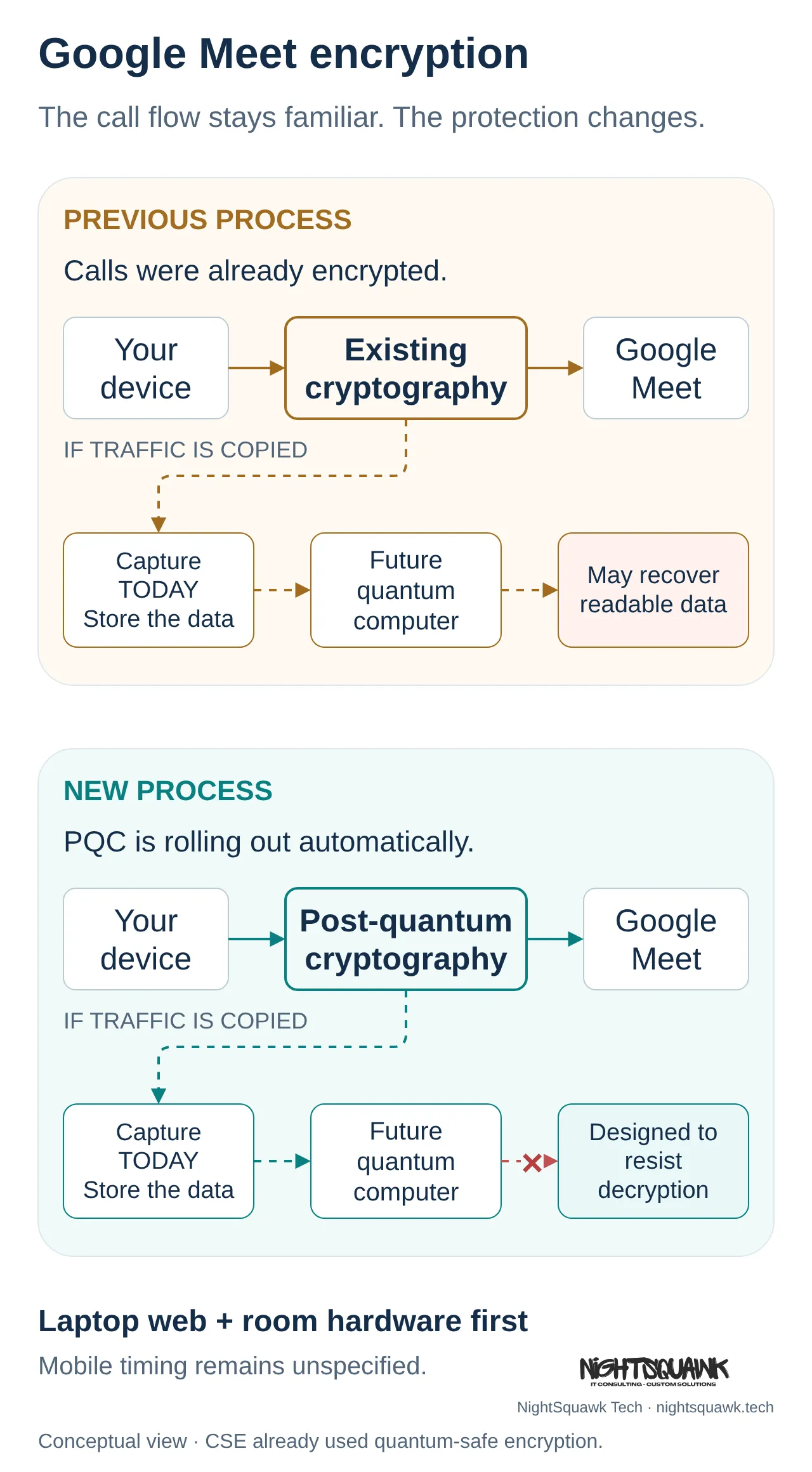
Google describes this as an expansion of quantum-safe encryption it had previously used for client-side encrypted Meet calls. The announcement does not say that ordinary Meet calls have become end-to-end encrypted, that every call path or recording now uses PQC, or that the rollout protects compromised accounts or devices.
Who gets it, and when

Google lists all Google Workspace customers, Workspace Individual subscribers, and people using personal Google accounts as eligible. The gradual rollout for web clients and room hardware starts October 12 on both Rapid Release and Scheduled Release tracks. Google says the feature may take up to 15 days to become visible. That is a rollout window, not confirmation that every eligible device has already received it.
Mobile support is still pending, with no timing published in the announcement. If your organization has a requirement that specifically covers Meet on phones or tablets, leave that requirement open until Google provides a mobile availability date and scope.
PQC is separate from client-side encryption
PQC and client-side encryption (CSE) address different needs. The automatic PQC rollout is a cryptography update. CSE is a separate option that adds an encryption layer controlled through an organization’s identity provider and encryption key service. Google’s Meet CSE guidance describes separate setup requirements and lists Enterprise Plus, Education Standard, and Education Plus as eligible editions for CSE. Those requirements do not limit eligibility for the announced PQC rollout.
If your policy requires your organization to control encryption keys, assess CSE separately. The PQC announcement does not establish that this key-control requirement has been met.
What small businesses should do
For this rollout, there is no switch to find and no staff workflow to change, according to Google. Use this short check:
- Web or room hardware: Treat the update as gradual. Do not assume it is active on every device yet.
- Mobile requirement: Keep coverage unresolved until Google announces mobile availability.
- Organization-controlled keys: Review your CSE needs, edition, and setup separately from PQC.
- Everyday safeguards: Continue managing account access and device security. This announcement does not establish protection from compromised accounts, devices, or participants.
Sources
- Google Workspace team, “Google Meet now uses post-quantum cryptography,” Google Workspace Updates, October 12, 2026. https://workspaceupdates.googleblog.com/2026/10/google-meet-now-uses-post-quantum-cryptography.html
- Google, “Learn about Meet client-side encryption (CSE),” Google Meet Help, publication date not shown. https://support.google.com/meet/answer/11605714
- Google, “Google Meet Security & Privacy for users,” Google Meet Help, publication date not shown. https://support.google.com/meet/answer/9852160
Editorial note: This article was researched and drafted with AI assistance using Google’s Workspace announcement and Google Meet Help pages linked above. Rollout details reflect Google’s October 12, 2026 announcement; mobile timing was not specified.